

Soggy Sauerkraut, Glyphosate Warnings, & Hope
I love making sauerkraut. My mom and my grandma both made sauerkraut. It was something we made every year, when the cabbage was ready.
And let's not forget the health benefits of Sauerkraut. Improves digestion, supports the immune system, heart, brain, and bone health. I try to have a little sauerkraut or kimchi with every meal.
So I know how to make sauerkraut. But starting one year, my sauerkraut started to be stinky, moldy, mushy, soggy, Ugh! It was frustrating—batch after batch. I couldn't figure out what I was doing wrong.
I switched salt, I disinfected everything, I tried everything I could think of, and I still couldn't get a good batch of sauerkraut. After a few years of bad sauerkraut, I gave up.

What changed? Why couldn't I make sauerkraut anymore?!
Then in 2024, I heard about the "Saga of the Soggy Sauerkraut." It is the story of a commercial sauerkraut maker who lost $1 million because of soggy sauerkraut and their journey to finding the answer.
They had the same problem I had.
After many tests, they found that the conventional chicken manure that they applied to the organic cabbage field was contaminated with glyphosate. The chicken manure contained glyphosate residues that chelated many minerals, preventing the cabbage from forming a proper cell wall due to mineral deficiency. You can read all about the "Saga of the Soggy Sauerkraut" by clicking the link in my resources. (6)
The fact that glyphosate was found in the chicken manure and then in the soil shows that glyphosate does not "disappear". They are finding it in everything, even human breast milk.(3) I know that nursing women are not drinking glyphosate, so where are they getting it from? Studies have also shown accumulation in the kidneys, liver, colon, and human fluids. Once again, if glyphosate goes away, why is it accumulating in people? Why did they find it in the chicken manure?
In December at the ACRES USA conference, I attended a day-and-a-half Symposium titled Agriculture Beyond Glyphosate. It was truly depressing and hopeful at the same time. Dr. Don Huber has been warning people for decades about the dangers of glyphosate. His talk was titled: "You have been warned; warn your neighbors." So I am warning you.

There are NO peer-reviewed scientific studies showing that glyphosate is safe for human or animal consumption. We have been lied to before about the safety of chemicals; DDT comes to mind. Too bad our children are not as important as Bald Eagles.
I will touch on the 3 patents Glyphosate has.
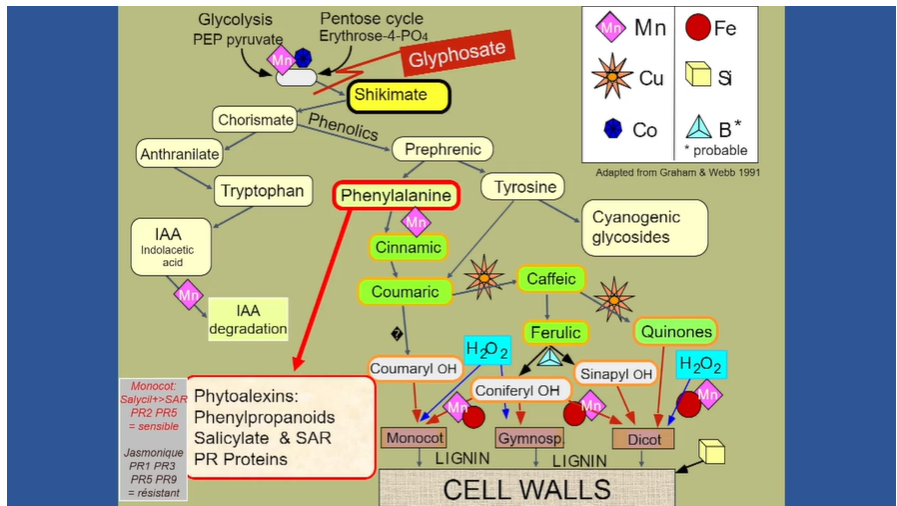
First, Glyphosate was patented in 1961 by Stauffer Chemical Co. as a descaling and chelating agent. Descaling agents are used to remove mineral deposits from the pipes and boilers of residential and commercial hot water systems. They are effective metal binders that make the metals water-soluble and easily removable from the pipes. In the case of glyphosate, it ties up essential minerals such as Calcium (Ca), Cobalt (Co), Copper (Cu), Potassium (K), Manganese (Mn), Magnesium (Mg), Iron (Fe), and Zinc (Zn). Many of these minerals are needed for optimal human, animal, and plant health.
Copper is a critical micronutrient in plants, vital for various physiological processes, including lignification, according to Martha Carlin. Cu is needed for strong cell walls.
Insects also attack plants that have nutrient deficiencies or diseases. The purpose of "insect pests" is nature's way to get rid of weak and diseased plants.
For instance:
Aphids attack plants that are low in Ca, P, Fe, and Cu.(2)
Colorado Potato Beetles attack plants that are low in Ca, P, vitamin C, Cu, and Mn.(2)
The goal should be to get the soil healthy, then the plants will be healthy, and you will not need to use insecticides. We have seen it in the greenhouse. One plant will be completely covered in aphids, and the next one touching it will be as beautiful as ever, not an aphid on it. Why? One is a healthy plant, the other is sick.
"Iron, copper, zinc, and manganese are critical trace elements necessary for the formation of collagen. In humans, Cu deficiency, along with zinc and iron deficiency or dysregulation, can result in poor collagen formation, leading to joint issues, weakened connective tissues, and other health problems.(5) All these minerals are being chelated by glyphosate.
Second, in 1974, Glyphosate was patented as a herbicide by Monsanto. Glyphosate shuts down the Shikimate pathway to kill the weed. While we humans do not have a Shikimate pathway, many of our gut microbes do. The Human Microbiome Project found that 732 out of 941 bacteria species in our gut have at least one copy of the gene that glyphosate targets.(3) That's over 55% of our gut microbiome that is being affected by glyphosate. They have also found that glyphosate downregulates 291 enzymes because of its chelating properties.(1) What is that doing to our gut health and our human health?
Glyphosate is also being used as a desiccant on crops such as wheat, oats, and barley. This is so that the crops dry down and "ripen" evenly right before harvest.

Third, glyphosate was patented in 2010 as an antibiotic. It is toxic to many of our beneficial organisms in the soil and gut; however, it seems to help all the bad ones, like E. coli, Salmonella, Listeria, and Clostridium.(1) That doesn't sound like a good thing to have happen.
Glyphosate went from 7.7 million pounds in 1990 to 250 million pounds in 2014, and it's more now. And it's not just farmers. Roundup is being used by homeowners, in parks, and at schools at alarming rates. Cancer is at an all-time high, and so is the use of glyphosate. Is there a correlation?
This is just glyphosate; we do not even know what else is in Roundup that could be harming us in other ways.
These facts that glyphosate is a decaling and chelating agent, a herbicide, and an antibiotic are some of the truly depressing, but here is my hope.
In one study, an organic diet intervention reduced urinary glyphosate levels by 70.93% and its main metabolite, AMPA, by 76.71% within six days.(3)
We can change from the bottom up by supporting local organic farmers. Growing your own food which can be a great exercise and very rewarding, while also helping with local/national food security. Stop spraying Roundup in your yards and gardens so that you and your children are not directly exposed to it. There are natural weed killers that you can make yourself, such as the vinegar and salt combination. This year, we will be trying the Bioherbicide, Firehawk, in the greenhouse as another alternative.
Switching to an organic diet, as mentioned above, will reduce your exposure. Processed foods have some of the highest levels of glyphosate contamination; eliminating it from your diet will help reduce your exposure.
Now for the Silver lining of the Saga of the Soggy Sauerkraut. Because the company had so much unsellable sauerkraut, they spread it on the fields to dispose of it. They found that the sauerkraut actually broke down the glyphosate. Without the soggy sauerkraut, they wouldn't have found out that sauerkraut juice actually destroys glyphosate. God is so amazing!
Sauerkraut juice has been proven to degrade glyphosate in the soil. It also improved milk production in a controlled field study. (Harle,et al. 2024) Increased forage yield is another benefit they are discovering with the use of sauerkraut juice. This is because all the tied-up minerals are being released into the soil and can now be used by the plants again.
Back to my questions. What changed? Why couldn't I make sauerkraut anymore?
I moved my garden to a spot that had been sprayed with chemicals before we turned organic over 16 years ago. And I used compost from a conventional farm. Unfortunately, it has been found that glyphosate does not break down during the composting process. Important minerals were being chelated, so the cell structure of my cabbage was not as strong as it needed to be to make good sauerkraut.
This year, we plan to put sauerkraut juice on our gardens and farm to release the bound micronutrients in the soil. In fact, we just brought in twenty totes to spray on our fields in the spring.
There is hope!

Resources:
Acres USA Conference, December, 2025, Agriculture Beyond Glyphosate Symposium https://acresusa.com/
Andersen, Dr. Arden, The Anatomy of Life & Energy in Agriculture, 2014
Armstrong, A. 2025. Understanding glyphosate's growing presence in agriculture and its effects on human health. Mercola Reports, January 28, 2025
Campbell-McBride, Dr. Natasha, Gut and Psychology Syndrome, 2012,
Carlin, Martha. Side Effects of Glyphosate in Food Dec 10, 2025. https://www.westonaprice.org/health-topics/side-effects-of-glyphosate-in-food/#gsc.tab=0
Huber, Dr. Don, et al. Saga of the Soggy Sauerkraut https://journals.ashs.org/hort/hort/published/rest/pdf-watermark/v1/journals/hortsci/59/11/article-p1618.pdf/watermark-pdf/
Huber, Dr. Don, Professor Emeritus, Purdue University. Impacts of Glyposate on Soil, Crop, Animal, Human, and Environmental Health
Leu, Andre, The Myths of Safe Pesticides, 2014


Many articles online repeat the same ideas repeatedly, but this one managed to stay interesting. The writer used simple language and organized the information carefully. The section discussing 66 Lottery game was informative and easy to understand. Further into the article, 66 Lottery game appeared again with extra information that strengthened the overall discussion. The content maintained a consistent quality throughout.